Blog
Yamaha 2 Stroke Outboard Motor

Yamaha 2 Stroke Outboard Motor: Power, Uses and Buying Guide
SEO Title: Yamaha 2 Stroke Outboard Motor Buying Guide
Meta Description: Learn how to choose a Yamaha 2 Stroke Outboard Motor for fishing, transport, and work. Compare models, benefits, maintenance tips, and buying advice.
URL Slug: yamaha-2-stroke-outboard-motor
A good outboard motor can make the difference between a productive day on the water and a costly breakdown. For fishing boats, transport vessels, workboats, and smaller recreational craft, many owners want an engine that delivers strong power without a complicated design.
A Yamaha 2 Stroke Outboard Motor remains a popular choice in many marine markets. Yamaha offers two-stroke models across several power ranges. The range includes compact engines for small boats and larger V6 models for demanding applications. Yamaha also continues to offer Enduro models designed for tough commercial use.
So, what makes these engines attractive? They are generally light, compact, responsive, and relatively simple to maintain. However, choosing the right model requires more than looking at horsepower.
This guide explains the main benefits, model options, applications, maintenance needs, and buying points you should understand before making a decision.
Table of Contents
- What Is a Yamaha 2 Stroke Outboard Motor?
- Why Choose a Yamaha Two-Stroke Engine?
- Popular Yamaha Two-Stroke Models
- Yamaha Two-Stroke vs Four-Stroke
- Choosing the Right Engine
- Maintenance Tips
- Common Mistakes to Avoid
- Pro Tips
- Frequently Asked Questions
- Conclusion
What Is a Yamaha 2 Stroke Outboard Motor?
A two-stroke outboard completes its basic combustion cycle in two piston strokes. This design uses fewer major moving parts than a four-stroke engine.
As a result, two-stroke engines can offer a useful combination of low weight, compact size, and strong power output. Yamaha describes its two-stroke outboards as lightweight and compact, with high power output and relatively easy maintenance.
Many Yamaha models use carburetors and pre-mixed fuel and oil systems. However, specifications can vary by model and market. Therefore, always check the exact owner’s manual and model specification before preparing fuel or servicing the engine.
The Yamaha range covers several power levels. Current Yamaha information lists two-stroke models from small 4 hp engines through larger 200 hp models.
Why Choose a Yamaha Two-Stroke Engine?
There are several reasons boat owners continue to consider two-stroke outboards.
1. Lightweight Design
Weight matters on a boat. A lighter engine can help reduce the load on the transom and may make the boat easier to handle.
For example, Yamaha lists the 15F at about 36–38 kg with propeller, while the 40X ranges from about 72–81 kg, depending on configuration.
2. Simple Mechanical Design
Two-stroke engines have fewer mechanical components than many four-stroke designs. That can make routine servicing easier for experienced technicians.
This advantage can become especially useful in remote areas where access to advanced workshop equipment may be limited.
3. Strong Acceleration
A well-matched two-stroke engine can deliver quick throttle response. This feature helps when a boat needs to get onto plane quickly or move through challenging water.
4. Commercial Durability
Yamaha developed its Enduro range with commercial fishing and transport applications in mind. Yamaha states that the series is designed for harsh conditions and long periods of continuous operation.
That makes the Enduro family especially relevant for working boats.
5. Wide Range of Applications
These engines can suit many types of boats and activities, including:
- Fishing boats
- Passenger boats
- Utility boats
- Small transport vessels
- Workboats
- Tender boats
- Recreational boats
- Coastal commercial vessels
Yamaha also notes that its Enduro two-stroke engines are widely used in African fishing communities, where boats may operate under heavy loads and demanding conditions.
Popular Yamaha Two-Stroke Models
The right engine depends on boat size, hull design, passenger load, operating conditions, and intended use.
8 HP to 15 HP Models
Smaller engines work well on lightweight boats, tenders, small fishing boats, and utility craft.
The 15F, for example, uses a 246 cc two-cylinder engine and produces 15 hp at 5,000 rpm. Yamaha lists a dry weight of approximately 36–38 kg.
These engines are useful when portability and simple operation matter.
25 HP to 40 HP Models
The 25 hp, 30 hp, and 40 hp classes provide more thrust for larger boats.
Yamaha’s current 40X specification lists a 703 cc two-cylinder engine producing 40 hp at 5,000 rpm. The model can be configured with different shaft lengths and starting or control systems depending on the version.
For commercial users, the Enduro versions can also be worth considering.
60 HP to 75 HP Models
For heavier fishing and workboats, the 60 hp and 75 hp classes offer a substantial increase in power.
The Yamaha E75B uses a three-cylinder, 1,140 cc engine and produces 75 hp at 5,000 rpm. Depending on configuration, it can use manual or electric starting and tiller or remote controls.
85 HP to 200 HP Models
Larger boats may require much more power.
Yamaha’s published two-stroke range includes the 85A and the 200A/L200A. The 200A/L200A uses a 90-degree V6 engine with 2,596 cc displacement and produces 200 hp at 5,000 rpm. Yamaha lists electric starting, remote control, and power trim and tilt for this model.
However, bigger is not always better. An oversized engine can add unnecessary weight and may not suit the boat’s approved power range.
Yamaha Two-Stroke vs Four-Stroke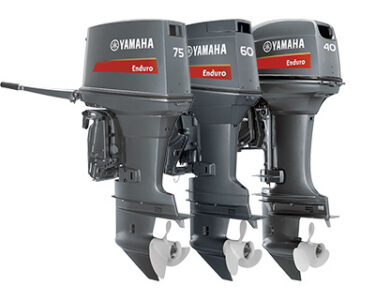
Both engine types have advantages.
| Feature | Two-Stroke | Four-Stroke |
|---|---|---|
| Weight | Often lighter | Often heavier |
| Mechanical design | Simpler | More complex |
| Acceleration | Strong and responsive | Smooth and controlled |
| Fuel system | Varies by model | Varies by model |
| Maintenance | Often straightforward | More components to service |
| Commercial use | Very popular in some markets | Popular across many markets |
| Fuel efficiency | Depends on model and use | Often strong in modern designs |
| Best for | Weight-sensitive and demanding applications | Efficiency-focused applications |
The choice should depend on the boat and operating pattern rather than engine type alone.
For example, a commercial fisherman who values simplicity and easy field service may prefer a two-stroke. Meanwhile, a recreational owner who places a high priority on fuel economy and quieter operation may prefer a modern four-stroke.
Choosing the Right Engine
Selecting the correct outboard requires careful planning.
Match Horsepower to the Boat
Start with the boat manufacturer’s recommended horsepower range.
Do not choose an engine based only on speed. The engine must work safely with the hull, transom, steering system, propeller, and total operating load.
Check Shaft Length
Shaft length is another important point.
An incorrect shaft can place the propeller too high or too low in the water. That can reduce performance and may increase the risk of poor cooling or ventilation.
Measure the boat’s transom carefully before ordering an engine.
Consider the Boat’s Load
Think about the real operating weight.
Include:
- Passengers
- Fuel
- Fishing equipment
- Cargo
- Batteries
- Safety equipment
- Coolers
- Anchors and ropes
A boat that carries heavy loads every day needs an engine matched to that workload.
Consider Your Water Conditions
Saltwater, shallow water, mud, weeds, strong currents, and long operating hours can place extra demands on an outboard.
For harsh commercial environments, Yamaha’s Enduro range is specifically designed around durability and continuous use.
Maintenance Tips
Good maintenance can protect performance and reduce unexpected downtime.
Inspect the Cooling System
The cooling system needs regular attention. Check the water flow and inspect the water pump according to the manufacturer’s service schedule.
A weak cooling stream can indicate a problem that needs immediate attention.
Use the Correct Fuel and Oil
Always follow the exact fuel and lubrication instructions for your model.
Some Yamaha two-stroke models use pre-mixed fuel and oil. For example, Yamaha lists pre-mixed lubrication for several current 2-stroke and Enduro models.
Do not guess the oil ratio. Use the owner’s manual for your exact engine.
Inspect the Propeller
A damaged propeller can cause vibration and reduce performance.
Check for:
- Bent blades
- Cracks
- Fishing line
- Heavy corrosion
- Loose hardware
Remove fishing line carefully and inspect the propeller shaft before returning the boat to service.
Flush After Saltwater Use
Salt can cause corrosion over time. Follow Yamaha’s recommended flushing procedure after saltwater operation.
Also inspect external fasteners, cooling passages, and sacrificial components as part of routine care.
Common Mistakes to Avoid
Buying the engine is only part of the process. Avoid these common mistakes.
Choosing too much horsepower: More power does not automatically mean better performance.
Ignoring shaft length: The wrong shaft can affect handling and propeller performance.
Using the wrong oil mixture: Incorrect lubrication can damage a two-stroke engine.
Ignoring the propeller: Even a strong engine can perform poorly with an unsuitable propeller.
Skipping routine service: Small problems can become expensive repairs.
Buying without checking the model: Yamaha offers different specifications for different countries and markets. Yamaha also warns that product names, specifications, and availability can vary by region.
Pro Tips
Here are practical tips from a marine service perspective:
- Match the engine to the hull first. Then choose the model.
- Check the transom measurement twice before ordering.
- Keep the owner’s manual on board or stored safely.
- Inspect the propeller regularly, especially on fishing boats.
- Use genuine or correctly specified service parts where appropriate.
- Keep fuel clean and fresh.
- Do not ignore unusual vibration, smoke, noise, or loss of power.
- Record service dates and repairs so you can track the engine’s condition.
- Ask a qualified marine technician to inspect a used engine before purchase.
- Confirm local parts and service support before choosing a model for commercial work.
Frequently Asked Questions
1. Is a Yamaha two-stroke outboard reliable?
Yes. Yamaha continues to offer two-stroke models for markets where durability, simple design, and commercial performance remain important. Its Enduro series is specifically designed for demanding fishing and transport applications.
2. What horsepower options are available?
Yamaha’s current published two-stroke range includes models from 4 hp through 200 hp, although availability depends on the country and market.
3. Are two-stroke outboards easy to maintain?
Their mechanical design is relatively simple compared with many four-stroke engines. However, correct servicing still matters. Always follow the manufacturer’s maintenance instructions.
4. What is the Yamaha Enduro series?
Enduro is a Yamaha two-stroke range developed mainly for commercial fishing and transport boats. Yamaha highlights durability and reliability for harsh conditions and long periods of operation.
5. Is a 40 hp Yamaha two-stroke good for fishing?
It can be an excellent option for a suitable fishing boat. The final choice depends on hull size, boat weight, passenger load, operating conditions, and the manufacturer’s horsepower recommendation.
6. What does shaft length mean?
Shaft length describes the distance between the engine mounting area and the propeller. The correct length places the propeller at the proper depth below the hull.
7. Can I use a two-stroke outboard in saltwater?
Yes, many two-stroke outboards operate in saltwater. However, saltwater increases corrosion risk, so regular flushing, inspection, and proper maintenance are important.
8. Is a 200 hp two-stroke suitable for every large boat?
No. The boat must be rated for that power, and the engine must match its transom, weight, steering system, propeller, and operating requirements.
9. Should I buy a new or used engine?
A used engine can provide good value if it has been properly maintained. Before buying, inspect compression, cooling, lower-unit condition, propeller shaft, electrical components, corrosion, and service history.
10. Where can I find the correct specifications?
Start with Yamaha’s official marine information and the owner’s manual for the exact model. Specifications can differ by country, model year, and configuration.
Quick Summary
A Yamaha 2 Stroke Outboard Motor can be a strong choice for boat owners who need simple operation, responsive performance, manageable weight, and dependable serviceability.
The range covers small portable engines, mid-range commercial models, Enduro workhorses, and large engines such as the 200A/L200A.
The most important step is choosing the engine for the actual boat and workload. Consider horsepower, shaft length, boat weight, water conditions, propeller selection, fuel and oil requirements, and access to service support.
A Yamaha 2 Stroke Outboard Motor remains a practical option for many boat owners around the world. Its lightweight design, simple mechanical layout, quick response, and strong commercial reputation make it particularly useful for fishing, transport, and demanding marine work.
Still, the best engine is not simply the one with the highest horsepower. It is the engine that matches your boat, load, water conditions, and daily operating needs.
Before you buy, verify the exact model specification, shaft length, control system, fuel and oil requirements, and local service support. If you are replacing an existing engine, have the boat and transom checked by a qualified marine professional.
Ready to choose your next outboard? Compare the available Yamaha two-stroke models carefully, confirm your boat’s requirements, and choose an engine built for the work you actually do on the water.